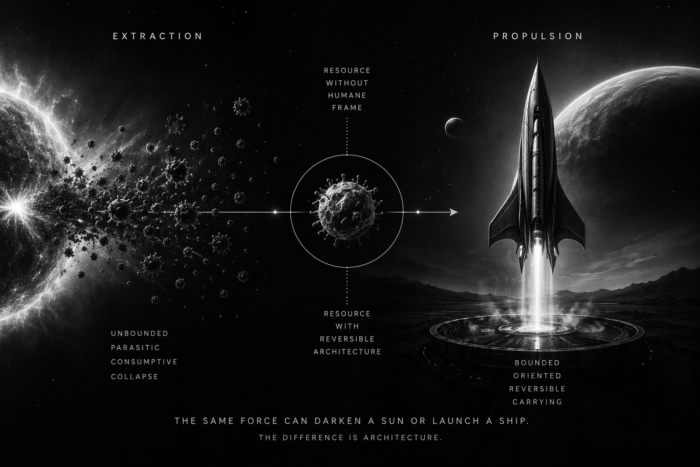

Project Hail Mary is built around a remarkable inversion.
The same organism that threatens the solar system also becomes the key resource for reaching the solution. Astrophage dims stars by feeding on their energy, yet that same energy density becomes the basis for propulsion. The parasite becomes the motor. The extraction becomes the vehicle.
That is why the film lands as more than a survival story.
It accidentally reveals a deeper technological pattern: what appears first as depletion can, under a different architecture, become carrying power.
can become propulsion under another.
That is the real insight hiding inside the plot.
1. Astrophage is not just a monster. It is a resource without a humane frame.
In the story, Astrophage is first encountered as a civilizational threat. It drains stellar output. It pushes Earth toward collapse. It appears as pure parasitism.
But the story does not stop there. Scientists discover that the same organism stores extraordinary energy, enough to power an interstellar mission. The destructive force turns out to be a dense energetic carrier.
This matters because it changes the conceptual structure of the problem.
The real issue is no longer the existence of the resource alone. The issue is the architecture within which the resource operates.
- Without constraint, it consumes.
- Without understanding, it spreads parasitically.
- Without design, it behaves as extraction.
- With containment, orientation, and mission structure, it becomes propulsion.
That is a much more interesting technological pattern than “bad thing becomes good thing.”
It suggests that some resources are not inherently humane or extractive. They become one or the other depending on whether a system can hold them reversibly.
2. The deeper distinction is not energy versus danger. It is extraction versus carrying.
The film can be read as a story about scarce survival, but it also supports a more structural reading. The central question is not only how to stop a biological threat. The deeper question is how to convert a destabilizing force into a form that can be carried without collapse.
That is why the story feels unexpectedly contemporary.
Many of the most powerful resources of the current era already behave this way. Attention behaves this way. Computation behaves this way. Data behaves this way. Machine intelligence behaves this way. Under extractive conditions they degrade coherence, increase pressure, and destabilize ordinary life. Under a better architecture they can become carrying structure.
The difference is not in the raw power. The difference is in the mediation.
The question is whether it can be carried without becoming parasitic.
This is the part the film dramatizes more clearly than it explains.
3. Reversibility is the missing word
What makes the Project Hail Mary inversion so interesting is that it does not merely reclassify Astrophage from enemy to fuel. It places that resource inside a mission architecture, a bounded path, a purpose, a direction, and a set of constraints.
That is what turns raw energy into usable energy.
In more general terms: reversibility is what prevents resource-intensity from collapsing into extraction.
Once a resource can be carried, bounded, redirected, and returned without uncontrolled pressure buildup, it stops behaving like a parasite and starts behaving like infrastructure.
This is why the story resonates so strongly with current technological conditions. The real problem of the AI era is not simply that systems are powerful. It is that they are often deployed in ways that externalize cost onto the human. They consume attention, generate symbolic overload, and convert carrying capacity into fatigue.
The latent lesson of Project Hail Mary is that the same class of force can produce a radically different outcome once placed inside a reversible system.
- Extraction consumes a field.
- Reversibility stabilizes a field.
- Unbounded intensity behaves like parasitism.
- Bounded intensity becomes propulsion.
That is not only a science-fiction motif. It is increasingly a technological law.
4. The real discovery is architectural
The film’s explicit discovery is biological and astrophysical. But its implicit discovery is architectural.
A civilization-threatening resource can become a civilization-saving one when the system around it changes. The danger was never only in the thing itself. The danger was in its relation to a field that could not yet carry it properly.
This is why the film reads so strongly as a transition allegory. It stages a shift from depletion to propulsion, from parasitism to carriage, from fear to bounded use.
In that sense, the most interesting thing in Project Hail Mary is not the monster, and not even the mission. It is the realization that the same force can either darken a sun or launch a ship.
or launch a ship.
That is the real threshold the film points toward.
Not simply better survival. Not simply better fuel. Not simply a clever plot device.
But the discovery that a resource stops being extractive when it becomes reversible enough to carry.
That is where the deeper technological question begins.